
Every fire safety business is, at its core, in the business of managing assets. Extinguishers, sprinkler heads, alarm panels, suppression systems, hose reels, emergency lighting — each one is a physical device with its own install date, inspection history, and compliance clock. Multiply that across dozens or hundreds of client sites, and it becomes clear why so many fire protection companies eventually hit a wall with spreadsheets and paper files. Asset management software exists precisely to solve this problem, and for fire safety businesses, it’s quickly moved from a “nice to have” to an operational necessity.
The Asset Problem Fire Safety Businesses Can’t Ignore
Unlike many field service industries, fire protection isn’t just about completing a job — it’s about tracking a device through its entire lifecycle. A single fire extinguisher might need monthly visual checks, an annual inspection, a five-year hydrostatic test, and a full replacement at the end of its service life. An alarm panel might have dozens of connected devices, each requiring its own test record. Without a system built to track this at the device level, it’s nearly impossible to know, with confidence, that every asset across every client site is actually compliant.
This is the gap that a dedicated fire asset management tracking system is designed to fill — giving technicians and office staff a single source of truth for every device, rather than a patchwork of paper logs and best guesses.
What Asset Management Software Actually Does
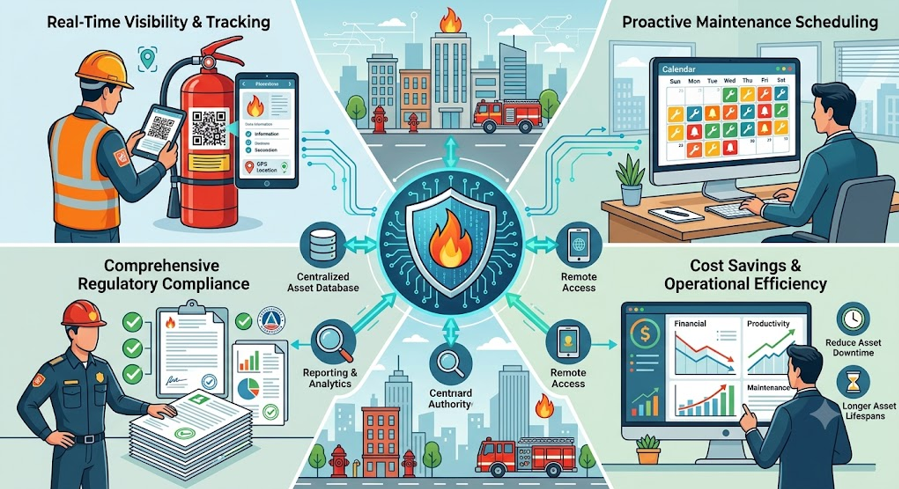
At a basic level, asset field services software allows a business to register every piece of equipment it services, attach a full history to it, and track what’s due next. For fire safety businesses, this typically includes:
- Device-level records — make, model, install date, location within a site, and full inspection history.
- Automated compliance scheduling — so monthly, quarterly, and annual test cycles are tracked without relying on memory or manual calendars.
- Barcode or QR-based identification, letting technicians scan a device in the field to instantly pull up its history.
- Deficiency tracking, so a failed test converts directly into a follow-up work order rather than a note that gets lost.
- Reporting, giving clients and regulators a clean, exportable record of every test performed on every device.
This is where fire asset management software overlaps closely with broader fire safety management software platforms — the asset tracking layer feeds directly into scheduling, inspections, and compliance reporting, rather than existing as a separate silo.
Why This Matters More for Fire Safety Than Almost Any Other Industry
Compliance Isn’t Optional
Fire and life safety codes require documented, recurring testing — and the consequences of missing a test aren’t just financial. A missed inspection on a fire extinguisher or sprinkler system is a genuine safety risk, not just a paperwork gap. Fire extinguisher compliance software and fire sprinkler compliance software exist specifically to make sure that risk doesn’t slip through the cracks of a busy schedule.
Assets Are Scattered Across Many Sites
A property manager overseeing a portfolio of buildings, or a fire protection contractor servicing dozens of commercial clients, is effectively managing thousands of individual assets spread across locations they don’t visit every day. Manual tracking simply doesn’t scale past a certain point. Fire safety for property managers in particular depends on having a system that can surface, at a glance, which sites have overdue inspections and which are fully compliant.
Every Device Has a Paper Trail Requirement
Insurers, fire marshals, and auditors all expect documented proof that equipment has been tested on schedule, by a qualified technician, using the correct procedure. Life safety inspection software with built-in asset tracking makes that documentation automatic rather than something office staff have to reconstruct after the fact.
Key Benefits of Asset Management Software for Fire Safety Businesses
1. Eliminates Guesswork Around Compliance Status
Instead of manually cross-referencing spreadsheets to figure out which devices are due for testing, fire compliance software with asset tracking surfaces this automatically. Office staff can see, in real time, exactly which assets across which sites need attention — turning compliance from a reactive scramble into a proactive, manageable process.
2. Speeds Up Field Work
When technicians can scan a device and instantly see its full history — rather than digging through paper files or calling the office — inspections move faster. Fire extinguisher service software and fire alarm service software built around barcode or QR scanning cut down significantly on the administrative overhead of every site visit, letting technicians complete more jobs per day.
3. Reduces Errors and Lost Records
Paper inspection tags get damaged, go missing, or simply don’t get filed correctly. A digital asset record doesn’t degrade, doesn’t get left in a truck, and can’t be misplaced in an office filing cabinet. For a fire protection maintenance software platform, this reliability is often the single biggest quality-of-life improvement office staff notice after switching from paper-based systems.
4. Strengthens Client Trust
Clients — especially commercial property owners and managers — want proof that their sites are protected and compliant. Being able to hand over a clean, exportable asset history report, rather than a vague verbal assurance, builds credibility. This is especially valuable for fire protection service management software users managing long-term service contracts, where client retention often comes down to how well a business can demonstrate reliability over time.
5. Supports Better Business Decisions
Asset data isn’t just useful for compliance — it’s useful for planning. A business can see which devices are approaching end-of-life, which sites generate the most recurring work, and where equipment failures cluster. Fire management software with strong reporting turns raw inspection data into decisions about staffing, replacement planning, and client account management.
6. Scales With the Business
A five-technician company might get by tracking assets in a spreadsheet. A fifty-technician company, servicing hundreds of sites, simply can’t. Fire protection business software with asset management built in scales naturally as a company grows — new sites and devices get added to the same system rather than requiring an entirely new tracking method.
How Asset Management Fits Into the Bigger Software Picture
Asset tracking rarely functions well as a standalone tool — its real value comes from how tightly it connects to the rest of a fire safety business’s operations. A well-built fire and life safety software platform links asset records to:
- Scheduling, so overdue assets automatically generate a job.
- Inspections, so field data updates the asset’s history in real time.
- Billing, so completed inspections translate directly into invoices.
- Reporting, so clients and regulators can be given documentation without manual compilation.
This is the model behind platforms often described as fire and security software or broader fire safety applications — asset management functioning as the backbone that inspections, scheduling, and accounting all connect to. Some businesses also draw on structured frameworks like those taught through capstone fire and safety management programs to inform how they organize asset data and compliance workflows, even when the software itself is doing the heavy lifting.
It’s also worth noting how this overlaps with adjacent disciplines. Functional safety management software, more common in industrial and process-safety contexts, shares the same underlying principle: a safety-critical asset needs a documented, auditable lifecycle, not just a one-time installation record. Fire safety businesses are, in effect, applying that same discipline to sprinklers, alarms, and extinguishers.
What to Look for in Fire Asset Management Software
For a fire safety business evaluating fire inspection software programs, the asset management component deserves particular scrutiny. Useful features to look for include:
- Barcode/QR scanning for fast, accurate device identification in the field.
- Automated compliance scheduling tied to each asset’s specific test cycle.
- Deficiency-to-work-order automation, so failed tests don’t require a separate manual follow-up process.
- Multi-site organization, so assets are grouped clearly by client and location.
- Exportable, audit-ready reporting for regulators, insurers, and clients.
- Mobile accessibility, since most asset updates happen on-site, not in an office.
Platforms built specifically for this industry — often marketed as streamline fire inspection software or fire code inspection software — tend to outperform generic asset trackers precisely because they’re designed around fire-specific test cycles and code requirements from the ground up.
Final Thoughts
Fire safety businesses don’t just sell a service — they take on responsibility for thousands of individual devices that need to work correctly when it matters most. Managing that responsibility with paper files or disconnected spreadsheets becomes riskier, and less efficient, with every new site added to the books. Fire extinguisher maintenance software and broader fire safety business software platforms with strong asset management at their core solve this by giving every device a permanent, searchable, auditable record — one that supports compliance, speeds up field work, and gives business owners the visibility they need to grow with confidence.
For any fire safety business weighing its next technology investment, asset management shouldn’t be treated as an optional add-on. It’s the foundation that everything else — scheduling, inspections, billing, and reporting — is ultimately built on.