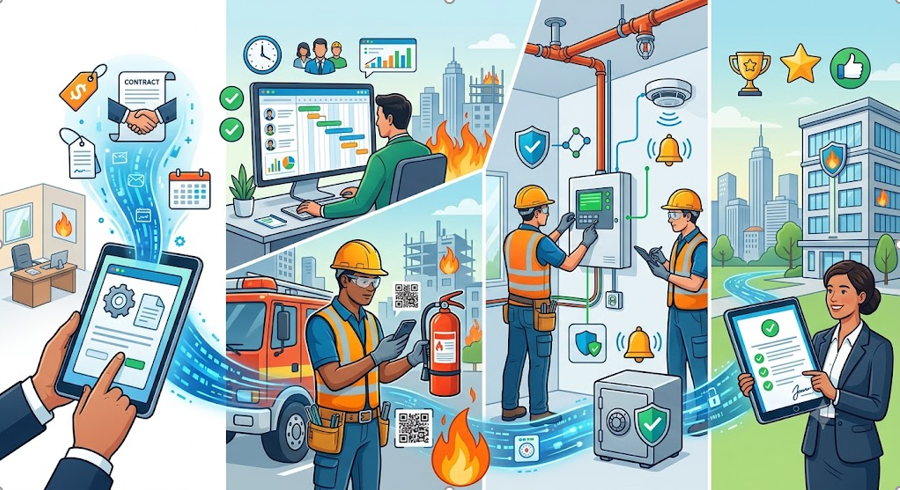
Every fire protection project — whether it’s a new sprinkler installation, an annual inspection contract, or a multi-site alarm rollout — moves through the same basic lifecycle: a quote is created, work is scheduled, technicians perform the job in the field, results are documented and reported, and finally the job is invoiced and closed. In theory, that sounds straightforward. In practice, most fire protection companies have historically managed each of these stages with a different tool, or worse, with no tool at all — just spreadsheets, paper forms, and phone calls holding the whole process together.
Cloud-based, subscription-delivered software — commonly known as SaaS (Software-as-a-Service) — has changed that. A single connected fire protection software platform can now carry a project from the initial quote all the way through completion, compliance documentation, and final billing, without the data gaps and manual re-entry that plague disconnected systems. This article walks through that entire lifecycle and shows how the right erp software for fire protection contractors eliminates friction at every stage.
Why the “Quote to Completion” Lifecycle Matters
Fire protection work isn’t a single transaction — it’s a chain of dependent stages, and a breakdown at any link creates downstream problems:
- A quote that doesn’t reflect accurate labor or asset data leads to underbilling or disputes later.
- A job that’s scheduled without visibility into technician availability leads to missed or delayed appointments.
- An inspection completed on paper in the field creates a lag — and a risk of lost data — before it ever reaches the office.
- A completed job that isn’t automatically tied to an invoice creates cash flow gaps.
- Compliance documentation that lives in a filing cabinet instead of a searchable system creates audit risk months or years later.
SaaS platforms solve this by keeping every stage of the project inside one system of record, accessible from the office and the field, updated in real time.
Stage 1: Quoting and Estimating
The lifecycle begins with a quote — and this is where accuracy sets the tone for everything downstream. Modern fire protection business software allows estimators to pull from existing client and asset history (number of extinguishers, sprinkler heads, alarm panels, square footage, prior service records) to generate accurate, consistent quotes instead of starting from scratch every time.
Because SaaS platforms are cloud-based, quotes can be created, adjusted, and approved from anywhere — in the office, on-site during a walkthrough, or remotely — with digital client sign-off replacing paper contracts. Once a quote is approved, it flows directly into the scheduling stage without needing to be manually re-entered, which is a critical advantage over disconnected quoting tools.
Stage 2: Scheduling and Dispatch
Once a project is approved, it needs to be scheduled — and this is where fire protection scheduling software becomes essential. Dispatchers get a real-time view of technician availability, certifications, and location, allowing jobs to be assigned efficiently rather than through guesswork or phone tag.
For recurring compliance work — extinguisher checks, sprinkler testing, alarm inspections — SaaS platforms can automatically generate future work orders based on code-mandated intervals (referencing standards like NFPA 10, NFPA 25, and NFPA 72), so re-inspections are scheduled proactively instead of tracked manually on a calendar. This is a core function of fire protection field service software, and it’s one of the biggest reasons compliance deadlines stop slipping through the cracks.
Stage 3: Field Execution with Mobile Tools
This is where the project moves from the office to the physical job site — and it’s historically been the weakest link in the chain. Paper-based inspection forms get lost, damaged, or filled out inconsistently, and there’s often a multi-day lag between a technician completing work and the office receiving documentation.
A cloud-based fire inspection software or fire inspector software mobile app changes this completely. Technicians complete standardized, code-referenced checklists directly on a tablet or phone, capture photos of any deficiencies, and get client sign-off on-site. As soon as the job is marked complete, the data syncs to the cloud — visible to the office in real time, with no re-entry required.
This stage is also where fire equipment inspection software, fire extinguisher testing software, and fire sprinkler inspection software modules do their heaviest lifting, guiding technicians through consistent, compliant inspection workflows regardless of experience level.
Stage 4: Compliance Documentation and Reporting
As soon as field work is completed, it needs to become part of a permanent, auditable record. SaaS-based fire safety compliance software automatically compiles inspection results, test data, photos, and deficiency notes into a structured report — generated instantly rather than typed up hours or days later from memory.
Because this data lives in the cloud, historical compliance records for every client and every asset are searchable in seconds, which matters enormously during an AHJ audit, insurance review, or client compliance request. Deficiencies identified in the field can automatically trigger a follow-up work order, closing the loop between “problem found” and “problem fixed” — a workflow that’s very difficult to manage reliably with paper-based systems.
Stage 5: Invoicing and Financial Close-Out
The final stage of the project lifecycle is billing — and it’s the stage most likely to fall through the cracks in businesses using disconnected tools. When job completion and invoicing live in separate systems, someone has to manually cross-reference which jobs are done, which have been billed, and which are still outstanding.
An integrated SaaS platform eliminates that gap. As soon as a job is marked complete in the field, it can automatically generate a billable event, syncing with accounting so invoices go out faster and cash flow improves. This is the core value proposition of dedicated fire protection accounting software — connecting field completion directly to financial outcomes instead of treating them as separate processes.
Why SaaS Specifically (Not Just “Software”)
The “as-a-Service” part of SaaS matters just as much as the software itself. Because these platforms are cloud-hosted and subscription-based, fire protection companies get:
- Access from anywhere — office staff, technicians, and managers can all work from the same live data, whether they’re in the office or on a job site
- Automatic updates — compliance checklists and code references can be updated centrally without requiring manual software installs across every device
- Scalability — the platform grows with the business, supporting more technicians, more clients, and more service lines without a full system overhaul
- Lower upfront cost — subscription pricing avoids the large capital investment of traditional on-premise software
- Built-in data security and backup — critical for compliance records that may need to be retained and retrieved years later
This is a major reason so many fire protection companies are consolidating their operations into a single all-in-one erp solution for fire protection contractors, rather than stitching together separate tools for quoting, scheduling, inspections, and accounting.
The Case for an End-to-End Platform Over Point Solutions
It’s possible to manage each stage of the project lifecycle with a different specialized tool — one app for quoting, another for scheduling, a separate one for inspections, and a standalone accounting system. But every handoff between disconnected systems is a place where data gets duplicated, delayed, or lost entirely.
An integrated fire protection service management software platform — functioning as a true erp software for fire protection contractors — keeps the entire project lifecycle connected:
- A quote becomes a scheduled job with no re-entry
- A scheduled job becomes a field inspection with a guided, compliant checklist
- A completed inspection becomes a compliance record and, if needed, a follow-up work order
- A completed job becomes an invoice automatically
The result is a business that moves faster, documents more accurately, and gets paid sooner — with a complete, defensible compliance trail at every step.
What to Look for in a Quote-to-Completion SaaS Platform
When evaluating fire protection software to manage the full project lifecycle, prioritize platforms that offer:
- Integrated quoting and estimating tied to existing client and asset data
- Automated scheduling for both one-time projects and recurring compliance work
- Mobile-first field tools for technicians, with offline capability for low-signal job sites
- Code-based digital checklists aligned to NFPA and local AHJ standards
- Deficiency tracking with automatic follow-up work order generation
- Real-time syncing between field completion and office visibility
- Integrated invoicing triggered directly by job completion
- Centralized, searchable compliance records across all clients and sites
- Scalability to support growth without adding administrative overhead
Final Thoughts
The journey from an initial quote to a completed, compliant, invoiced job involves far more moving parts than it might first appear — and every disconnection between stages introduces risk, delay, or lost revenue. SaaS-delivered fire protection business software closes those gaps by keeping quoting, scheduling, field execution, compliance documentation, and billing inside one connected system, accessible in real time from anywhere.
For fire protection companies looking to grow, the goal isn’t just digitizing individual tasks — it’s adopting a true end-to-end platform that carries every project smoothly from quote to completion, while building an airtight compliance record along the way.