
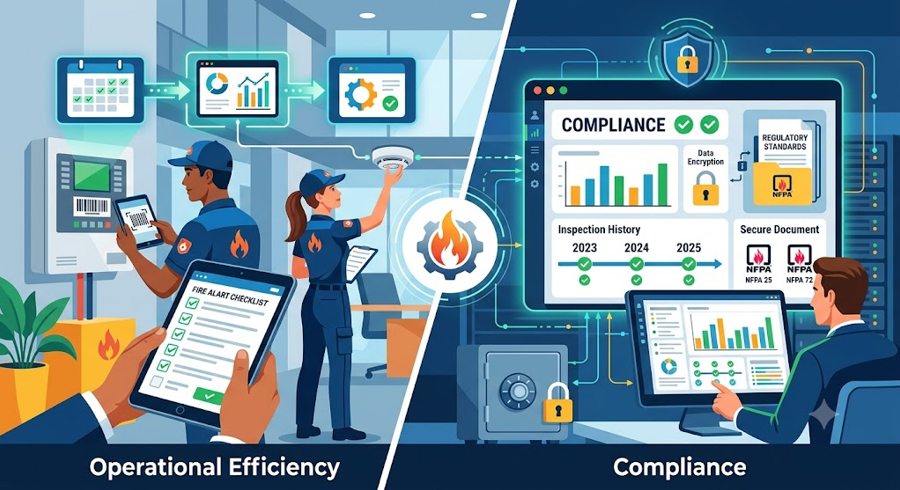
Fire protection companies operate in one of the most heavily regulated service industries in the world. Every fire extinguisher inspection, sprinkler test, and alarm check is tied to strict codes set by authorities like the NFPA, AHJs (Authorities Having Jurisdiction), and local fire marshals. A single missed inspection or a lost paper report doesn’t just create administrative headaches — it can result in failed audits, fines, lawsuits, or worse, a life-safety system that fails when it’s needed most.
For decades, fire protection contractors managed this complexity with clipboards, spreadsheets, and filing cabinets. Today, that approach simply can’t keep pace with growing client rosters, tightening code requirements, and customers who expect real-time visibility into their compliance status. This is where fire protection software steps in — purpose-built technology that helps fire and life safety businesses stay compliant, run leaner, and scale with confidence.
This article breaks down exactly how modern fire safety software transforms compliance management and day-to-day operations, and what to look for when choosing a platform for your business.
The Compliance Challenge Fire Protection Businesses Face
Before looking at solutions, it’s worth understanding the scale of the problem. A typical fire protection contractor might be responsible for:
- Fire extinguisher inspections (monthly, annual, and hydrostatic testing cycles)
- Fire sprinkler system inspections and flow tests
- Fire alarm testing and monitoring compliance
- Backflow preventer testing
- Kitchen hood suppression system checks
- Emergency and exit lighting inspections
- Fire pump testing
Each of these has its own inspection frequency, documentation requirements, and code reference (NFPA 10, NFPA 25, NFPA 72, and more). Multiply that across hundreds or thousands of client sites, each with multiple devices and systems, and you get an enormous compliance burden — one that’s nearly impossible to manage accurately with manual processes.
This is precisely the gap that fire compliance software and fire safety compliance software are designed to close.
What Is Fire Protection Software?
Fire protection software (also referred to as fire protection business software, fire and life safety software, or a life safety inspection platform) is a digital system that helps fire and life safety companies manage inspections, testing, scheduling, reporting, and business operations from a single platform. It typically combines:
- Mobile fire safety inspection software for field technicians
- Fire inspector software for creating and submitting digital reports
- Fire protection scheduling software for dispatch and route planning
- Fire protection accounting software for invoicing and billing
- Fire safety management software dashboards for owners and compliance managers
Rather than juggling separate tools for scheduling, inspections, and accounting, many fire and life safety businesses are now moving toward an integrated ERP software for fire protection contractors — essentially an all-in-one operating system for the business.
How Fire Protection Software Improves Compliance
1. Standardized, Code-Compliant Inspection Checklists
One of the biggest risks in manual inspections is inconsistency. A fire house inspection software or fire station inspection software platform provides digital, code-referenced checklists — for example, an NFPA 10-aligned checklist within fire extinguisher inspection software, or an NFPA 25-based checklist inside fire sprinkler inspection software. Technicians are guided step by step, which drastically reduces the chance of a skipped test point or an incorrectly documented deficiency.
Whether it’s a fire department checklist software tool used internally or a fire agency checklist software solution used for AHJ submissions, standardized digital checklists ensure every technician — regardless of experience level — follows the same compliant process every time.
2. Automated Scheduling Prevents Missed Inspections
Missed re-inspection dates are one of the most common compliance failures. Fire protection scheduling software automatically tracks due dates for every device and system at every client site and generates recurring work orders before a deadline is missed. This turns compliance from a reactive, memory-dependent task into a proactive, automated workflow.
3. Real-Time, Digital Documentation
Paper reports get lost, damaged, or filled out illegibly. Fire inspect software and software inspect extinguishers tools let technicians complete inspections directly on a tablet or phone, capture photos of deficiencies, get client sign-off digitally, and sync the report to the cloud instantly. This creates a permanent, audit-ready digital trail — critical during an AHJ audit or insurance review.
4. Barcode and Asset-Level Tracking
Fire extinguisher barcode inspection software allows technicians to scan a barcode or QR code on each device to instantly pull up its inspection history, location, and next due date. This asset-level tracking eliminates guesswork, prevents duplicate or missed inspections, and creates a clean digital chain of custody for every extinguisher, sprinkler head, or alarm panel on a property.
5. Deficiency Tracking and Corrective Action Management
Modern fire code inspection software doesn’t just flag a failed test — it tracks the deficiency through to resolution. If a sprinkler valve fails inspection, the system can automatically generate a follow-up work order, notify the client, and keep a record until the issue is corrected and verified. This closed-loop process is exactly what auditors and AHJs want to see.
6. Centralized Records for Multi-Site and Multi-System Compliance
For clients with multiple properties, a fire systems inspection software platform consolidates every inspection, test, and certificate into one searchable record. This is especially valuable for fire alarm compliance software and fire sprinkler compliance software, where a single missed system across dozens of buildings can create significant liability.
How Fire Protection Software Improves Operational Efficiency
Compliance is only half the story. The same platforms that reduce risk also streamline how fire protection businesses operate day to day.
1. Faster Field Service with Mobile Apps
Fire sprinkler compliance apps and fire extinguisher compliance apps let technicians complete inspections in the field without returning to the office to file paperwork. Reports sync automatically, freeing up hours per technician per week that were previously spent on data entry.
2. Smarter Route and Technician Scheduling
Fire protection field service software and fire safety field service software optimize technician routes and job assignments based on location, certification, and availability. This reduces windshield time, increases the number of jobs completed per day, and improves response times for urgent repairs.
3. Streamlined Billing and Cash Flow
Fire protection accounting software built specifically for the industry connects completed inspections directly to invoicing — so a completed job automatically triggers a billable event instead of waiting for someone to manually cross-reference paperwork. This is a major advantage over generic accounting tools, since it accounts for recurring inspection contracts, deficiency-based repair billing, and service agreements unique to fire and life safety work.
4. A Single Source of Truth Across the Business
Rather than using one tool for scheduling, another for inspections, and a third for invoicing, a unified erp software for fire safety accounting and scheduling platform connects every department. Dispatch, technicians, compliance managers, and accounting all work from the same real-time data, eliminating duplicate entry and communication gaps.
5. Better Customer Experience and Retention
Clients increasingly expect self-service access to their compliance records — certificates, inspection history, and upcoming due dates — without having to call and ask. Fire safety service management software with a client portal builds trust and reduces administrative back-and-forth, which pays off in contract renewals.
6. Data-Driven Decision Making
With inspection, service, and financial data centralized, owners get real visibility into technician productivity, job profitability, overdue inspections, and revenue trends — insights that are nearly impossible to extract from paper records or disconnected spreadsheets.
Why ERP-Style Platforms Are the Future for Growing Fire Protection Businesses
As fire protection companies scale beyond a handful of technicians, disconnected point solutions start to break down. This is why more owners are searching for the best ERP for growing fire protection business rather than piecing together separate apps.
A true best erp system for fire life safety business combines:
- Inspection and testing workflows (fire equipment inspection software, fire alarm test and inspection software, fire sprinkler test and compliance software)
- Scheduling and dispatch
- Accounting and invoicing
- Customer and asset management
- Compliance reporting and audit trails
into one connected system, rather than five different logins. This consolidation is what allows a growing fire and life safety business to add technicians, clients, and service lines without a proportional increase in administrative overhead.
One platform frequently mentioned in this space is Uptick, known for its inspection, scheduling, and compliance workflow tools — people researching uptick features or uptick pricing are typically comparing it against other best fire inspection software options to find the right fit for their business size and service mix. When evaluating any platform, it’s worth comparing feature depth, pricing structure, and how well it fits your specific mix of extinguisher, sprinkler, alarm, and life safety services rather than choosing based on brand recognition alone.
Key Features to Look for in Fire Protection Software
If you’re evaluating fire safety business software for your company, prioritize platforms that offer:
- Code-based digital checklists aligned to NFPA and local AHJ requirements
- Mobile inspection apps for offline-capable, on-site reporting
- Barcode/QR asset tracking for extinguishers, sprinklers, and alarm devices
- Automated scheduling with recurring inspection reminders
- Deficiency and corrective action tracking
- Integrated accounting and invoicing tied to completed work
- Client portals for self-service access to compliance documents
- Reporting and analytics for operational and compliance oversight
- Scalability to support multiple service lines (extinguishers, sprinklers, alarms, kitchen suppression, backflow, etc.)
- Integration capabilities with existing accounting, CRM, or monitoring systems
Whether you need standalone fire alarm inspection management software, a dedicated fire extinguisher testing software tool, or a full fire protection service management software suite, the right choice depends on your company’s size, service mix, and growth plans.
Final Thoughts
Compliance in the fire and life safety industry isn’t optional, and the margin for error is razor-thin. Manual, paper-based processes may have worked for smaller operations, but as fire protection businesses grow, they introduce risk, inefficiency, and lost revenue.
Purpose-built fire safety software — whether it’s focused fire sprinkler compliance software, comprehensive fire and security software, or a full erp software for fire protection contractors — gives businesses the tools to standardize inspections, automate scheduling, maintain airtight documentation, and run a more profitable operation.
For companies serious about scaling, the goal isn’t just to digitize paperwork — it’s to adopt an integrated best erp for growing fire protection business platform that connects compliance, field service, and accounting into one system. That combination is what ultimately protects both the business and the lives the industry exists to safeguard.